From West Virginia Lawyer to Presidential Nominee
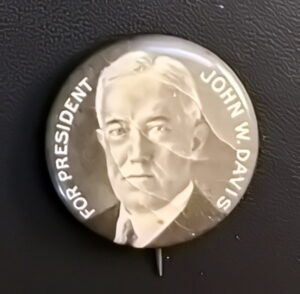
John William Davis stands as one of the most distinguished yet ultimately unsuccessful presidential candidates in American history. A brilliant lawyer, diplomat, and politician, Davis represented the Democratic Party’s presidential ticket in 1924, though his campaign would be remembered more for the tumultuous convention that nominated him than for any electoral success.
Early Life and Education
Born on April 13, 1873, in Clarksburg, West Virginia, John W. Davis was raised in a family deeply rooted in law and public service. His father, John James Davis, served as a delegate to the West Virginia constitutional convention and later as a member of the state legislature. This early exposure to politics and law would profoundly shape young John’s future aspirations.
Davis attended Washington and Lee University, where he excelled academically and graduated in 1895 with a law degree. His academic prowess and natural oratorical skills quickly distinguished him among his peers, foreshadowing the legal brilliance that would later make him one of America’s most sought-after attorneys.
Legal Career and Early Politics
Returning to West Virginia after graduation, Davis began practicing law in Clarksburg. His sharp legal mind and persuasive courtroom presence quickly earned him a reputation as one of the state’s most capable attorneys. By his early thirties, he had built a thriving practice and began to consider public service.
Davis entered politics as a Democrat, serving in the West Virginia House of Delegates from 1899 to 1901. His legislative experience provided valuable insights into the political process, though he remained primarily focused on his legal career during this period.
In 1910, Davis won election to the U.S. House of Representatives, where he served with distinction until 1913. As a congressman, he supported progressive legislation and demonstrated the moderate, thoughtful approach that would characterize his entire political career.
Ambassador to Great Britain
President Woodrow Wilson recognized Davis’s diplomatic potential and appointed him as the United States Ambassador to the Court of St. James’s (Great Britain) in 1918. This appointment came during the critical final months of World War I and the subsequent peace negotiations.
As an ambassador, Davis proved exceptionally skilled at navigating complex international relationships. He worked closely with British officials during the war’s conclusion and played a supporting role in the peace process. His tenure in London enhanced his international reputation and provided him with valuable foreign policy experience that would serve him well in later political endeavors.
Return to Law and the 1924 Presidential Campaign
After completing his ambassadorial duties in 1921, Davis returned to private practice, joining the prestigious New York law firm of Davis, Polk & Wardwell (now Davis Polk). His legal practice flourished, and he appeared before the Supreme Court in numerous high-profile cases.
The 1924 Democratic National Convention in New York City proved to be one of the most contentious in American political history. The party was deeply divided between urban and rural factions, with significant disagreements over Prohibition, the Ku Klux Klan, and cultural issues. The convention deadlocked for an unprecedented 103 ballots over nine days.
After the leading candidates – William Gibbs McAdoo and Alfred E. Smith – failed to secure the necessary delegates, the exhausted convention turned to Davis as a compromise candidate on the 103rd ballot. At 51 years old, he became the Democratic nominee, with Charles W. Bryan (William Jennings Bryan’s brother) as his running mate.
The 1924 Election
Davis faced a challenging electoral landscape in 1924. The Republican incumbent, Calvin Coolidge, benefited from a strong economy and the nation’s general satisfaction with Republican leadership. Additionally, Progressive candidate Robert La Follette split the opposition vote, drawing support from many traditional Democratic constituencies.
Davis ran a dignified campaign, focusing on issues of governmental reform, international cooperation, and moderate economic policies. However, he struggled to distinguish himself from Coolidge on major issues and failed to generate significant popular enthusiasm. His campaign was further hampered by limited financial resources and organizational challenges.
The election results were devastating for Davis. He received only 28.8% of the popular vote and carried just 12 states, all in the South. Coolidge won decisively with 54% of the vote, while La Follette captured 16.6%. It was one of the most lopsided presidential defeats in Democratic Party history.
Later Legal Career and Legacy
Following his electoral defeat, Davis returned to his law practice with characteristic grace and professionalism. Rather than dwelling on political disappointment, he channeled his energy into what would become one of the most distinguished legal careers in American history.
Davis argued an astounding 140 cases before the Supreme Court, winning approximately two-thirds of them. His clients included major corporations, foreign governments, and individuals involved in significant constitutional questions. He was widely regarded as one of the finest oral advocates ever to appear before the Court.
Perhaps ironically, given his Democratic politics, one of Davis’s most controversial cases came near the end of his career when he represented South Carolina in the landmark Brown v. Board of Education case, defending racial segregation in public schools. This decision damaged his reputation among liberals and civil rights advocates, though he maintained he was simply fulfilling his professional obligations as an attorney.
Personal Character and Assessment
Colleagues and contemporaries consistently praised Davis’s integrity, intelligence, and professionalism. He was known for his meticulous preparation, elegant speaking style, and unwavering ethical standards. Even political opponents respected his character and capabilities.
Davis’s presidential campaign, while unsuccessful, demonstrated his commitment to public service and his belief in moderate, principled governance. His willingness to accept the nomination during such a divisive convention showed both courage and party loyalty.
Death and Historical Significance
John W. Davis died on March 24, 1955, at the age of 81, having lived to see significant changes in American society and politics. While his presidential ambitions were unfulfilled, his contributions to American law and public service were substantial.
Davis represents an era of American politics characterized by greater civility and cross-party respect. His career illustrated the possibility of maintaining personal dignity and professional excellence even in the face of political defeat.
Though he lost the 1924 presidential election decisively, John W. Davis’s life exemplified the American ideal of public service combined with professional excellence. His story serves as a reminder that political success, while important, is not the only measure of a life well-lived in service to one’s country.
Conclusion
